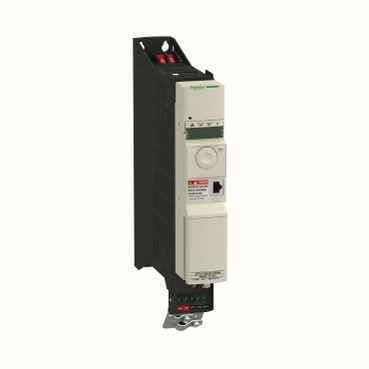
The ATV32H037N4 is a versatile variable speed drive from Schneider Electric, designed for efficient motor control in industrial settings.
Product ModelATV32H037N4
Product ID37198
Stock on Request
Last updated: 8/29/2026
Key Features
1
FeatureEfficient Motor Control
2
FeatureReliable Operation
3
FeatureEasy Installation
4
FeatureAdvanced Features
5
FeatureCompliance with Standards
6
Technical Specifications
Detailed engineering parameters based on manufacturer documentation
Specifications may be subject to change without notice
Parameter
Value
Parameter
Value
Range of Product
Altivar 32
Product or Component Type
Variable speed drive
Product destination
Synchronous motorsAsynchronous motors
Product Specific Application
Complex machines
Function Available
-
Assembly style
With heat sink
FeatureEfficient Motor Control
7
FeatureReliable Operation
8
FeatureEasy Installation
9
FeatureAdvanced Features
10
FeatureCompliance with Standards
Component name
ATV32
EMC filter
Class C2 EMC filter integrated
Phase
3 phase
[Us] rated supply voltage
380...500 V - 15...10 %
Supply voltage limits
323...550 V
Supply frequency
50...60 Hz - 5...5 %
Network Frequency
47.5...63 Hz
Motor power kW
0.37 kW 380...480 V
Maximum Horse Power Rating
0.5 hp 380...480 V
Line current
1.6 A 500 V 3 phase 0.37 kW / 0.5 hp2.1 A 380 V 3 phase 0.37 kW / 0.5 hp
Apparent power
1.4 kVA 500 V 3 phase 0.37 kW / 0.5 hp
Prospective line Isc
5 kA 3 phase
Nominal output current
1.5 A 4 kHz 500 V 0.37 kW / 0.5 hp
Maximum transient current
2.3 A 60 s 0.37 kW / 0.5 hp
Output frequency
0.0005...0.599 kHz
Nominal switching frequency
4 kHz
Switching frequency
2...16 kHz adjustable
Speed range
1...100 asynchronous motor in open-loop mode
Speed accuracy
+/- 10 % of nominal slip 0.2 Tn to Tn
Torque accuracy
+/- 15 %
Transient overtorque
170...200 %
Braking torque
<= 170 % with braking resistor
Asynchronous motor control profile
Voltage/frequency ratio, 5 pointsVoltage/frequency ratio - Energy Saving, quadratic U/fFlux vector control without sensor, standardVoltage/frequency ratio, 2 pointsFlux vector control without sensor - Energy Saving, NoLoad law
Synchronous motor control profile
Vector control without sensor
Regulation loop
Adjustable PID regulator
Motor slip compensation
Not available in voltage/frequency ratio (2 or 5 points)Adjustable 0...300 %Automatic whatever the load
Local signalling
1 LED red drive voltage1 LED green CANopen run1 LED red CANopen error1 LED red drive fault
Internal supply for reference potentiometer (1 to 10 kOhm) 10.5 V DC +/- 5 %, <10 mA overload and short-circuit protection
Analogue input number
3
Analogue input type
AI1 voltage 0...10 V DC 30000 Ohm 10 bitsAI2 bipolar differential voltage +/- 10 V DC 30000 Ohm 10 bitsAI3 current 0...20 mA (or 4-20 mA, x-20 mA, 20-x mA or other patterns by configuration) 250 Ohm 10 bits
Sampling duration
2 ms AI1, AI2, AI3) - analog2 ms AO1) - analog
Response time
LI1...LI6 8 ms +/- 0.7 ms logicR1A, R1B, R1C 2 ms relayR2A, R2C 2 ms relay
Accuracy
+/- 0.2 % AI1, AI2, AI3) for a temperature of -10...60 °C+/- 0.5 % AI1, AI2, AI3) for a temperature of 25 °C+/- 1 % AO1) for a temperature of 25 °C+/- 2 % AO1) for a temperature of -10...60 °C
Linearity error
+/- 0.2...0.5 % of maximum value AI1, AI2, AI3)+/- 0.3 % AO1)
Analogue output number
1
Analogue output type
AO1 software-configurable current 0...20 mA 800 Ohm 10 bitsAO1 software-configurable voltage 0...10 V 470 Ohm 10 bits
R1 3 A 250 V AC resistive, cos phi = 1R1 4 A 30 V DC resistive, cos phi = 1R1, R2 2 A 250 V AC inductive, cos phi = 0.4R1, R2 2 A 30 V DC inductive, cos phi = 0.4R2 5 A 250 V AC resistive, cos phi = 1R2 5 A 30 V DC resistive, cos phi = 1
Discrete input number
7
Discrete input type
Programmable (sink/source) LI1...LI4)24...30 V DC level 1 PLCProgrammable as pulse input 20 kpps LI5)24...30 V DC level 1 PLCSwitch-configurable PTC probe LI6)24...30 V DCSafe torque off STO)24...30 V DC - 1500 Ohm
CUSDeceleration ramp automatic stop DC injectionUDeceleration ramp adaptationSLinearRamp switching
Braking to standstill
By DC injection
Protection type
Input phase breaks driveOvercurrent between output phases and earth driveOverheating protection driveShort-circuit between motor phases driveThermal protection drive