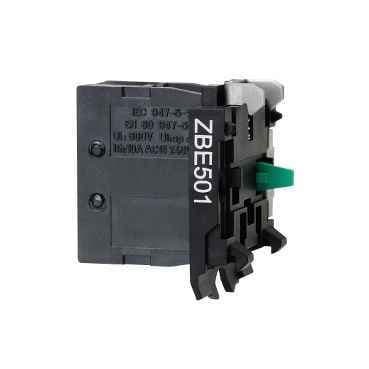
High power switching contact block for fast and easy replacement and configuration of control and signaling products.
Product ModelZBE501
Product ID28253
Stock on Request
Last updated: 8/29/2026
Key Features
1
FeatureIdeal for high power switching applications
2
FeatureFast and easy replacement of control and signaling products
3
FeatureFront fixing for secure installation
4
FeatureOperates within a temperature range of -40°C to 70°C
5
FeatureScrew clamp terminals for reliable connections
Technical Specifications
Detailed engineering parameters based on manufacturer documentation
Specifications may be subject to change without notice
Parameter
Value
Parameter
Value
Range of Product
Harmony XB5Harmony XB4
Product or Component Type
Contact block
Device short name
ZBE
Sale per indivisible quantity
1
IP degree of protection
IP20 IEC 60529
Contact operation
Slow-break
Contact block type
Single
Contacts usage
High power switching contacts
Connections - terminals
Screw clamp terminals, <= 1 x 2.5 mm² with cable endScrew clamp terminals, <= 2 x 1.5 mm² with cable endScrew clamp terminals, <= 2 x 2.5 mm² without cable endScrew clamp terminals, >= 1 x 0.5 mm² without cable end
Net Weight
0.04 lb(US) (0.02 kg)
Contacts type and composition
1 NO
Positive opening
Without
Mechanical durability
10000000 cycles
Short-circuit protection
10 A cartridge fuse gG IEC 60947-5-1
[Ith] conventional free air thermal current
10 A IEC 60947-5-1
[Ui] rated insulation voltage
300 VIEC 60947-1
[Uimp] rated impulse withstand voltage
6 kV IEC 60947-1
[Ie] rated operational current
1.1 A 125 V, DC-13, P300 IEC 60947-5-1
Mounting of block
Front mounting
Electrical composition code
C15 1)
Ambient Air Temperature for Storage
-40...158 °F (-40...70 °C)
Ambient Air Temperature for Operation
-40...158 °F (-40...70 °C)
Vibration resistance
5 gn 2...500 Hz)IEC 60068-2-6
Shock resistance
30 gn 18 ms) half sine wave acceleration IEC 60068-2-2750 gn 11 ms) half sine wave acceleration IEC 60068-2-27
ZBE501 High Power Switching Contact Block by Schneider Electric | INDPRT