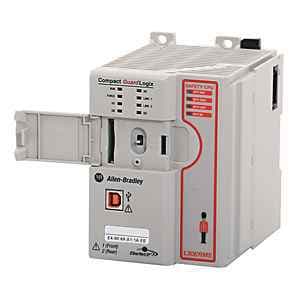
The Allen Bradley 1769-L36ERMS Compact GuardLogix controller is a compact, integrated safety controller with dual Ethernet ports, USB, and SD card support. It supports up to 16 axes of motion control and is certified for Performance Level (PL) and SIL 3.
Product Model1769-L36ERMS
Product ID109092
Stock on Request
Last updated: 8/29/2026
Key Features
1
1. Integrated Safety ControllerThe Allen Bradley 1769-L36ERMS is designed to meet stringent safety standards, offering certifications for Performance Level (PL) and SIL 3. This ensures reliable operation in critical applications.
2
2. Dual Ethernet PortsEquipped with two Ethernet ports, this controller supports up to 48 different Ethernet connections, facilitating seamless communication and network integration.
3
3. Motion ControlThe controller supports up to 16 axes of motion control via CIP Motion protocol, making it versatile for various industrial automation tasks.
4
4. Scalable DesignThe 1769-L36ERMS offers scalability, allowing it to connect with a wide range of industrial applications. It supports distributed, local I/O module control, and local extension modules.
5
5. Robust Communication OptionsWith support for dual Ethernet connectivity, Linear, Star, and DLR topologies, and a USB port for temporary connections, this controller ensures robust communication and flexibility in network configurations.
6
6. Memory and ExpansionThe controller features 1.5MB of safety memory and 3MB of standard memory. It also supports SD cards for non-volatile memory expansion and IP address configuration, enhancing its functionality and customization options.
7
7. Electrical and Environmental DurabilityThe 1769-L36ERMS is designed to withstand harsh industrial environments. It has a working shock resistance of up to 30 G when mounted on a panel and 20 G when installed on a DIN rail, along with electrostatic discharge immunity ratings of 6 kilovolts contact discharge and 8 kilovolts air discharge.
8
8. Programming FlexibilityThe controller supports various IEC-61131-3 programming languages, including structured text, sequential function chart, relay ladder, and function block, allowing for flexible programming and customization to meet specific application needs.